
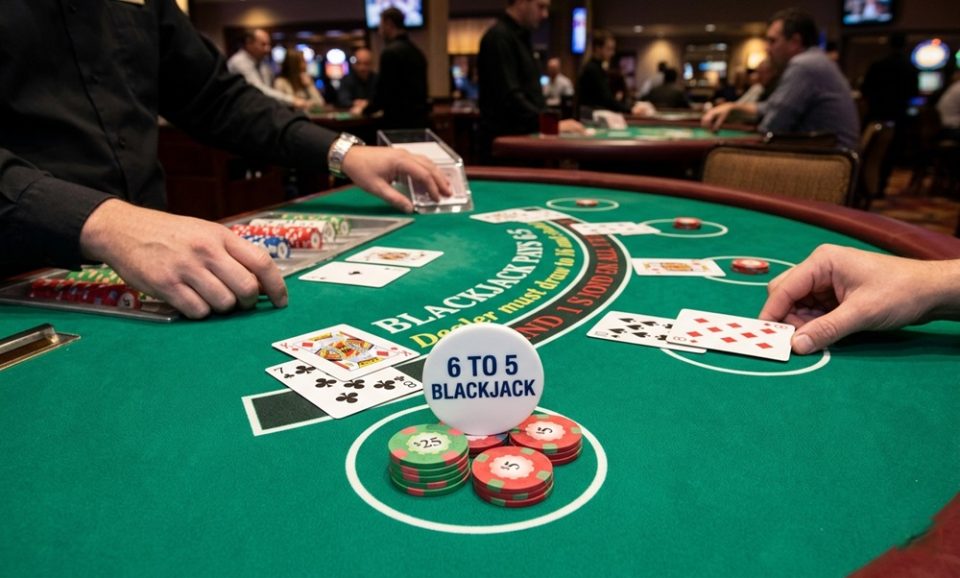
Most casino players know the basics of blackjack — hit, stand, don’t bust. But fewer pay attention to a small label on the table felt that can dramatically change how much they lose over time. 6 to 5 blackjack looks almost identical to a standard game, but one payout difference hands a significant extra edge to the house.
Here’s what it means, how it affects your money, and why experienced players avoid these tables whenever possible.
What Does 6 to 5 Mean in Blackjack?
When you’re dealt a natural blackjack — an ace plus any ten-value card on your first two cards — the table pays you according to a posted ratio.
- At a 3 to 2 table: A $10 bet wins you $15
- At a 6 to 5 table: A $10 bet wins you only $12
That $3 difference per blackjack might seem minor. But natural blackjacks occur roughly once every 21 hands. Over a few hours of play, that gap adds up to real money.
The House Edge Impact: By the Numbers
| Payout Rule | Additional House Edge Added |
|---|---|
| 3 to 2 (standard) | Baseline |
| 6 to 5 | +1.39% added to house edge |
A well-played blackjack game with standard rules carries a house edge of roughly 0.5%. The 6 to 5 rule alone pushes that to nearly 2% — four times worse for the player, before accounting for any other unfavorable rule changes that often accompany these tables.
Why Do Casinos Use 6 to 5 Blackjack?
Simple: it’s more profitable for them, and many players don’t notice.
The shift became widespread on the Las Vegas Strip starting in the early 2000s, initially on single-deck games marketed as “better” because of the reduced number of decks. But the single-deck advantage was more than offset by the 6 to 5 payout change.
Casinos learned that most recreational players don’t check the payout label before sitting down.
How to Spot a 6 to 5 Blackjack Table
Look at the felt on the table before you place any chips. It will say one of the following:
- “Blackjack pays 3 to 2” — This is the favorable version
- “Blackjack pays 6 to 5” — Walk away
- “Blackjack pays even money” — Even worse; avoid entirely
If you don’t see a payout ratio posted, ask the dealer before betting. Any reputable casino should tell you clearly.
Common Mistakes to Avoid
- Sitting down at a busy table without checking the felt. The excitement of finding an open seat shouldn’t override the basic rule check.
- Assuming single-deck automatically means better odds. Single-deck with 6 to 5 is actually worse than multi-deck with 3 to 2.
- Thinking basic strategy offsets the payout difference. It helps, but it can’t recover the full 1.39% you’re giving back on every blackjack hand.
Expert Insight
Seasoned blackjack players treat the payout ratio as the first filter — not the last. Before considering game speed, table minimums, or dealer friendliness, they confirm the payout. It’s the single rule that matters most.
FAQs
Q: Is 6 to 5 blackjack ever worth playing? Rarely. If it’s the only blackjack available in a given venue and you want to play, manage your bankroll conservatively. But as a consistent choice, it’s avoidable.
Q: Are online blackjack games 6 to 5 or 3 to 2? Most reputable online blackjack games use 3 to 2 — it’s one advantage online play has over many land-based options. Always check the game rules tab to confirm.
Q: Does the number of decks matter alongside the payout ratio? Yes, but the payout ratio has a larger impact. A 6-deck shoe paying 3 to 2 is better for players than a single deck paying 6 to 5.
Q: Where can I still find 3 to 2 blackjack in Las Vegas? Downtown casinos (Fremont Street area) tend to offer more 3 to 2 games than the Strip. Off-Strip locals casinos are also good options.
Conclusion
6 to 5 blackjack is one of the most player-unfriendly rule changes the casino industry introduced in recent decades. It looks like a minor tweak but adds real cost over every session. The fix is simple: check the felt before you sit, and if it says 6 to 5, find a better table. In a game where strategy already minimizes the house edge, paying attention to payout rules is the easiest win available.
